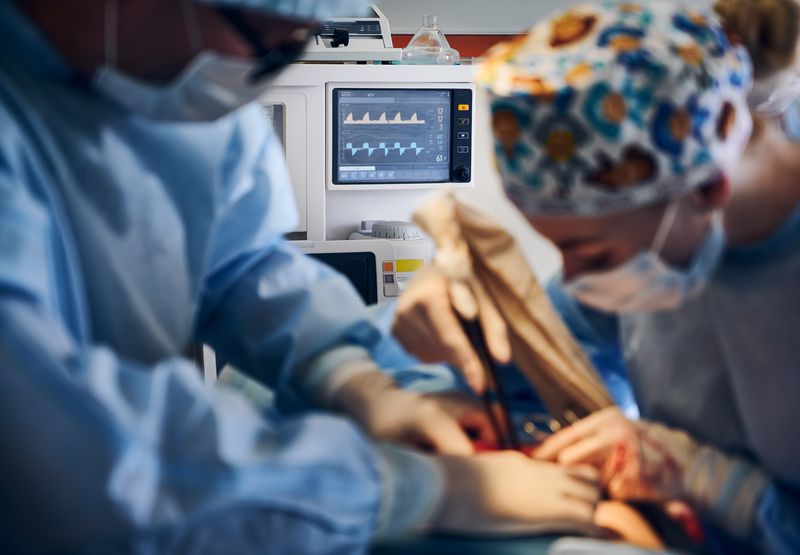
Who is a left atrial appendage closure for? The procedure is aimed at people with atrial fibrillation who have an elevated stroke risk and cannot tolerate or are not allowed to take blood thinners permanently. Typical reasons are repeated bleeding, a high risk of falling or side effects from the medication.
Whether the closure is worthwhile for you is something we determine together in a thorough consultation, based on your history and your values. Can I stop the blood thinners after the procedure? That is exactly the goal of left atrial appendage closure.
After a short transitional phase in which the implant grows in, permanent blood thinning can in most cases be ended. We set the exact plan individually and check the position of the implant by imaging before we change the medication. How does the procedure work?
The closure is carried out minimally invasively via a catheter that is guided through a vein in the groin to the heart. Through this access we place a small umbrella in the left atrial appendage and thereby close the site where most clots form in atrial fibrillation. Open-heart surgery is not needed for this.
Does the implant stay permanently in the heart? Yes. The implant remains permanently in the left atrial appendage.
Within a few weeks the body's own tissue covers the surface, so that it grows completely into the heart wall and is accepted by the body as part of the tissue. How long do the procedure and the hospital stay take? The procedure itself usually takes about an hour.
Mostly only a short inpatient observation is needed, often over one night. We discuss the exact course with you beforehand, so that you know what to expect. Is the procedure painful?
The closure is carried out, depending on the findings, under local anaesthetic with sedation or under a brief anaesthetic. During the procedure you feel nothing. At the puncture site in the groin a mild feeling of pressure may follow, which quickly subsides.
What happens after the procedure? After the closure we accompany you closely. We check by imaging that the implant is correctly positioned and has grown in cleanly, and we adjust your further medication accordingly.
If you have questions, you can reach your treating team directly.