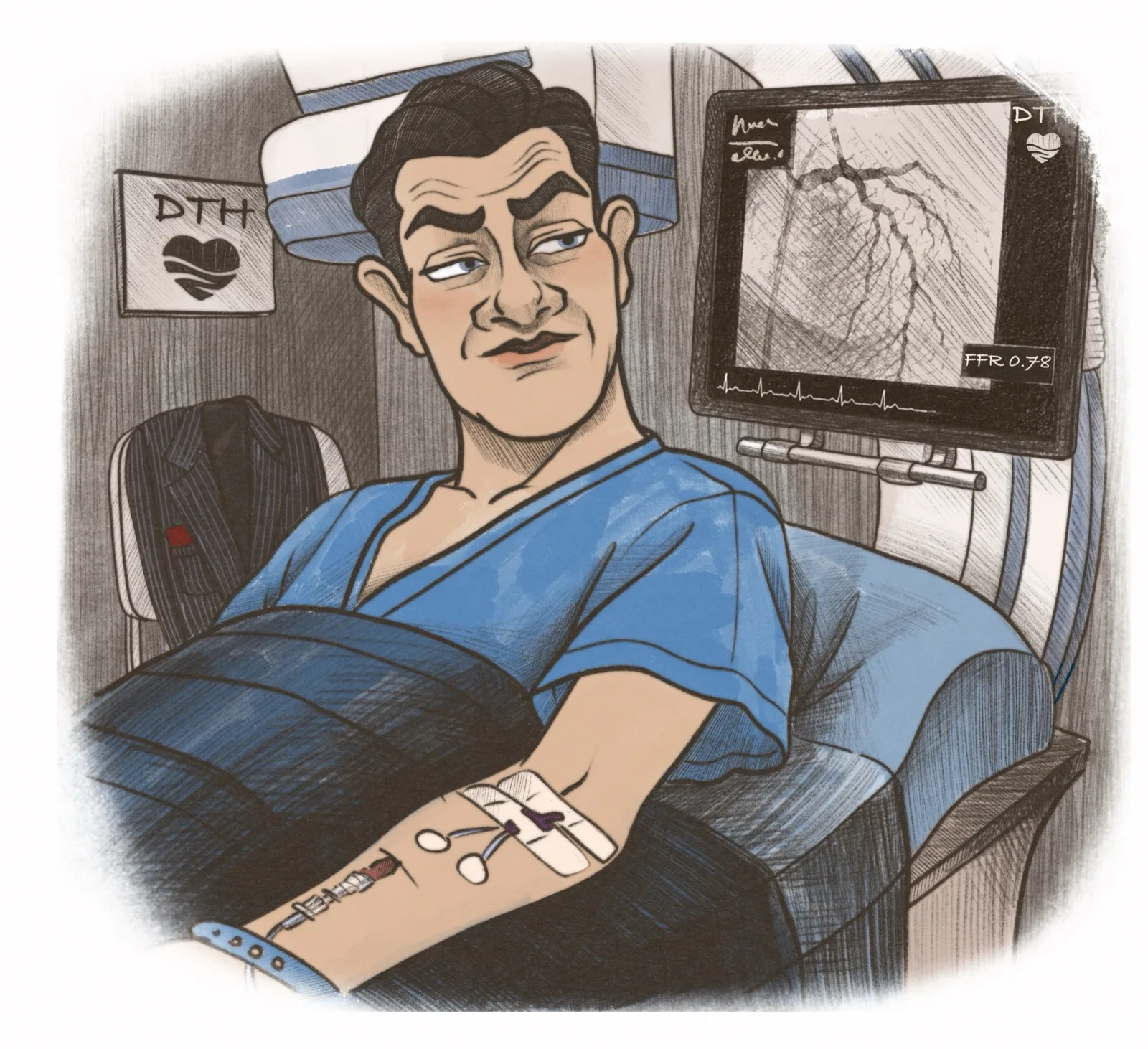
Am I awake during the procedure?
Yes. The PCI is carried out under local anaesthetic at the puncture site, and you are responsive throughout. If you are tense, we give you a mild sedative on request; a general anaesthetic is almost never needed.
How long do I stay in hospital?
After a planned PCI via the wrist you usually spend one night at the Klinik Im Park; with an uncomplicated course you can go home the next day. With an acute procedure or complex anatomy the stay can be longer. We discuss that with you individually.
Do I have to take medication afterwards?
Yes, after a stent implantation you need dual antiplatelet therapy, two light blood thinners that prevent blood platelets from sticking at the stent. The ESC guideline usually recommends this combination for 6 to 12 months, after which one preparation usually remains permanently \[ESC 2023, Eur Heart J\]. Exactly how long you need the combination, I determine according to your bleeding and re-occlusion risk.
When am I active again?
Since circulation is immediately improved after treatment, activity can be resumed straight away; only the wrist or the groin still needs to be spared for three days after the procedure.
Does a stent last forever?
The stent remains permanently in the artery and grows into the vessel wall. Today's drug-eluting stents keep the treated segment open, and a renewed blockage at the same site has become rare. What remains important is that we continue to treat the underlying disease with medication and lifestyle, so that no new narrowings form elsewhere.
Why via the wrist and not via the groin?
At Dein Team Herzzentrum we choose radial access via the wrist as standard. This route has a markedly lower risk of bleeding at the puncture site, and you can stand up again shortly after the procedure \[ESC 2018, Eur Heart J\]. We use access via the groin only when the anatomy of the wrist makes it necessary.
What distinguishes PCI from bypass surgery?
In PCI we open the narrowed coronary artery from the inside with balloon and stent, via a thin catheter and without open-chest surgery. A bypass operation surgically circumvents the narrowing. Which method is more suitable for you depends on the number and location of the narrowings; we decide that within the heart team together with you.