Cardiac Catheterisation & Coronary Angiography

FMH Cardiology · Zürich Utoquai

Cardiac Catheterisation & Coronary Angiography

The most precise examination of the coronary arteries. Through a thin catheter we make narrowings visible and treat them in the same procedure where needed.

Seeing and treating in one procedure

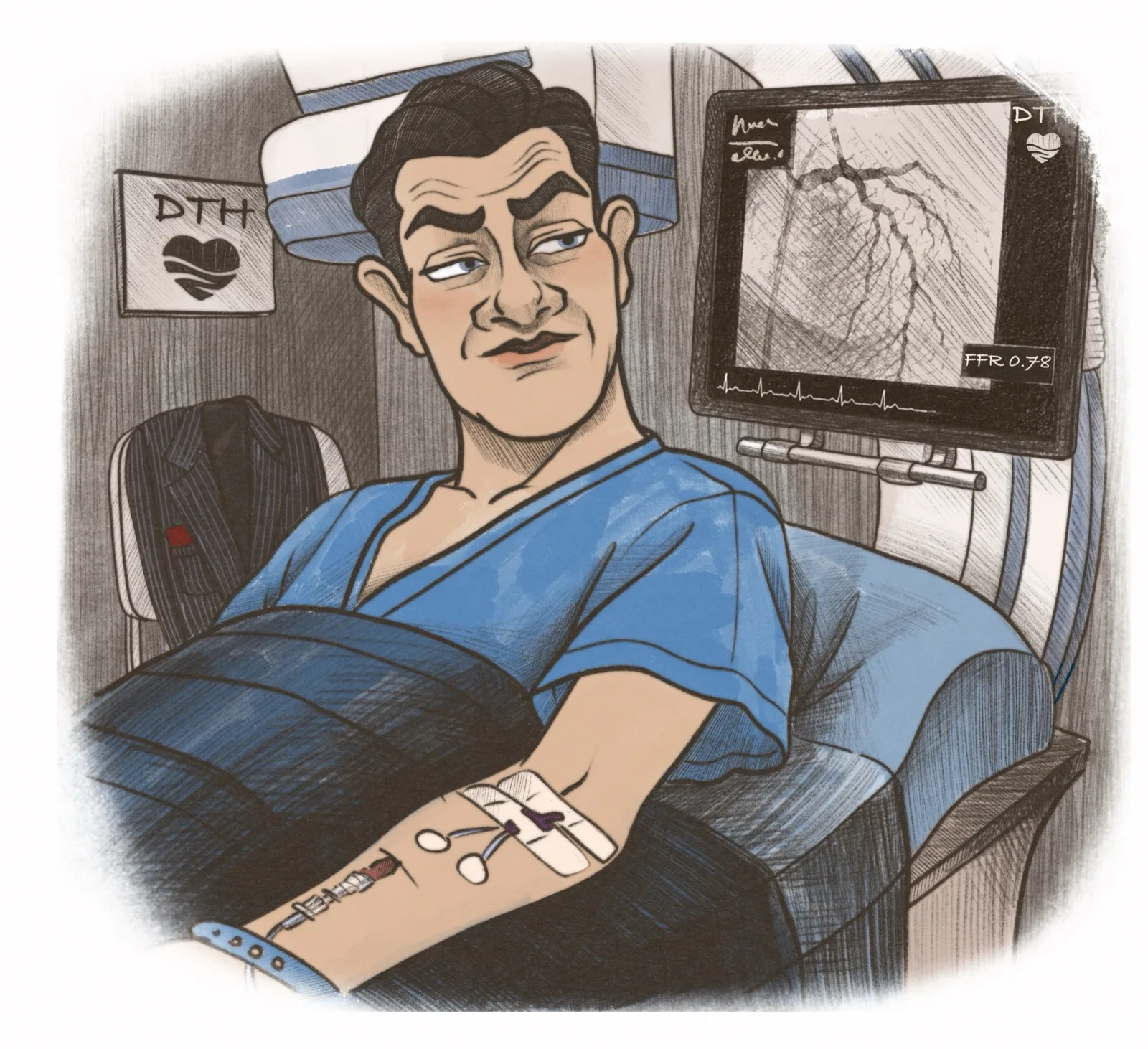
In cardiac catheterisation, your cardiologist guides a thin, flexible tube via the wrist to the heart. With contrast medium and X-ray, your coronary arteries become visible in real time. If a relevant narrowing appears, it can often be treated directly in the same procedure. You need no second appointment and no second preparation.

Request an appointment

Seeing and treating in one procedure

In cardiac catheterisation, your cardiologist guides a thin, flexible tube via the wrist to the heart. With contrast medium and X-ray, your coronary arteries become visible in real time. If a relevant narrowing appears, it can often be treated directly in the same procedure.

You need no second appointment and no second preparation.

When a cardiac catheterisation makes sense

Cardiac catheterisation is the most accurate method for assessing coronary heart disease. Your cardiologist recommends it when non-invasive tests such as the exercise ECG, CT or echocardiography point to a circulation problem.

Typical reasons are persistent chest tightness on exertion, an abnormal stress test or an acute coronary syndrome. A precise assessment of the coronary arteries may also be needed before major operations.

We discuss with you beforehand what we expect and which treatment options may arise, so that you go into the procedure well informed.

How the procedure unfolds

The procedure takes place in a specialised catheterisation laboratory at the Hirslanden Klinik Im Park. You stay awake throughout, and the puncture site is locally anaesthetised.

Via the artery at the wrist, your cardiologist guides the catheter to the coronary arteries. After contrast medium is given, the vessels are X-rayed and checked for narrowings. The diagnostic part alone usually takes 5 to 10 minutes.

After the procedure the puncture site is dressed with a pressure bandage. As a rule you can move the wrist again after a short time.

Via the wrist, not the groin

We prefer access via the artery at the wrist (radial access). This is considerably more comfortable for you than the classic access via the groin.

You can stand up again immediately after the procedure, the risk of bleeding is lower and you are mobile again sooner. Radial access is today the international standard for most catheter procedures.

Frequently asked questions about cardiac catheterisation

Does the procedure hurt?

No. The puncture site is locally anaesthetised, and you do not feel the catheter being advanced. Some people sense a brief feeling of warmth when the contrast medium is given.

How long do I have to stay?

With a purely diagnostic procedure you can usually leave the clinic the same day. If a stent is placed at the same time, you normally stay one night for observation.

Is the procedure dangerous?

Cardiac catheterisation is a very safe routine examination. Serious complications are rare. Your cardiologist discusses all risks with you beforehand.

Your team for the heart.

All articles on dth.healthcare →

Request Your appointment now

Cardiac Catheterisation & Coronary Angiography at Dedicated to the Heart. By phone or online, within 48 hours, no referral needed.